Dave and Linda are a fictional couple. The numbers are a realistic example of a 10-10-80 budget built with net income, and they match the 10-10-80 Monthly Budget page in the Freedom Account app. Your household will look different, and that's the point.
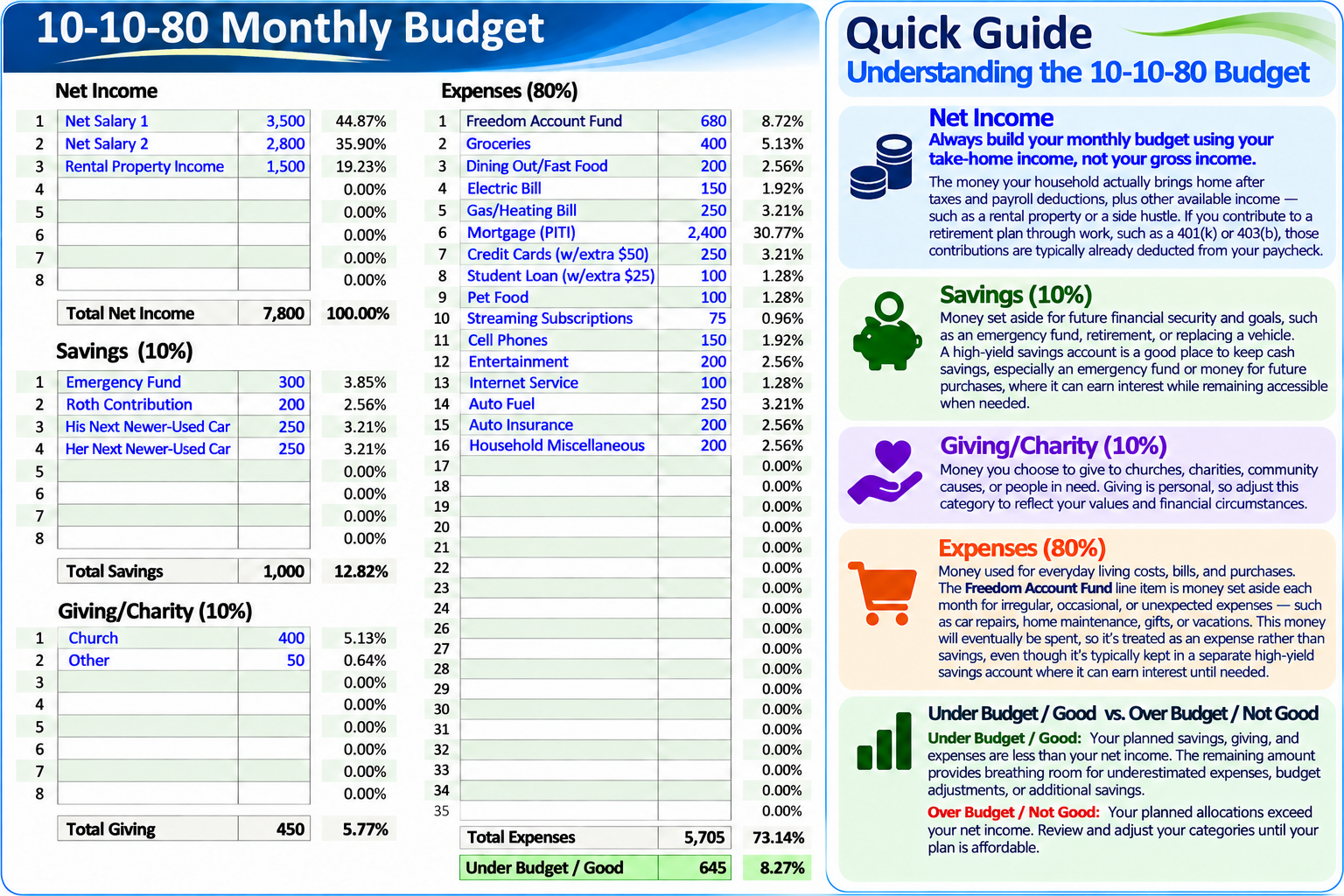
Their complete monthly budget with the Quick Guide. Click to enlarge and read every line.
How one everyday couple pays the bills, prepares for tomorrow, and still enjoys life along the way.
Dave and Linda are a married couple with jobs, a mortgage, cars to maintain, bills to pay, and things they enjoy doing together.
Over the years, they’ve learned a simple lesson: Spend less than you make, do it consistently, and plan ahead—because life happens.
They haven’t always gotten everything right. They’ve carried credit card debt, taken out a student loan, and faced unexpected expenses. But they’ve made steady progress and expect to be debt-free except for their mortgage within a few months.
Their goal isn’t to stop spending money. It’s to manage it wisely, prepare for tomorrow, and enjoy life along the way.
Let’s see how they do it.
How Their 10-10-80 Budget Works
The 10-10-80 approach provides a simple starting point for managing household income:
10% for savings: Building financial security and preparing for future goals.
10% for giving: Supporting people, charities, and causes that matter to you.
80% for living expenses: Paying bills, enjoying life, and preparing for future spending.
These percentages are guidelines, not strict rules. The goal is a realistic budget that works for your household.
Dave and Linda use net income—the money they actually bring home after taxes and paycheck deductions. Any contributions already deducted for employer-sponsored retirement plans, such as a 401(k) or 403(b), are additional retirement savings not shown in their monthly budget.
As you’ll see, their actual percentages differ from 10-10-80. That’s perfectly fine.
Their Monthly Income — $7,800
Dave’s Net Salary — $3,500
Dave works full-time and brings home $3,500 monthly after payroll deductions.
Linda’s Net Salary — $2,800
Linda also works, bringing home $2,800 monthly.
Rental Property Income — $1,500
Their small rental property provides another $1,500 monthly after rental-related expenses and reserves.
It’s their side hustle. For someone else, additional income might come from tutoring, freelancing, pet sitting, or selling handmade items.
Rather than automatically increasing their spending, Dave and Linda use this extra income to strengthen their financial position.
Total Monthly Net Income: $7,800
Their Monthly Savings — $1,000
Each savings category has a purpose.
Emergency Fund — $300
Dave and Linda are building a financial safety net for bigger surprises, such as a job loss, unexpected medical expenses, or other financial setbacks.
Their goal is three to six months of essential living expenses. They’ve already saved three months and are working toward six by contributing another $300 monthly.
It’s money they hope they’ll never need, but knowing it’s there provides peace of mind.
Roth Retirement Contribution — $200
They contribute $200 monthly to a Roth retirement account, building toward their future a little at a time.
They also consider any employer retirement plans and matching contributions available to them.
Saving for Their Next Newer-Used Cars — $500
His Next Newer-Used Car — $250
Her Next Newer-Used Car — $250
Rather than automatically taking out car loans, Dave and Linda each save $250 monthly toward purchasing their next reliable, newer-used vehicle with cash.
They call it making car payments to themselves instead of a lender.
Their savings can earn interest, and unlike a loan payment, their monthly contributions are flexible. If money gets tight, they can temporarily reduce or skip a deposit without late fees or missed loan payments.
They’ll keep their current vehicles as long as practical while saving for their replacements.
Their money. Their timeline. Their choice.
Total Monthly Savings: $1,000
Their Monthly Giving — $450
Church — $400
Supporting their church is important to Dave and Linda, so they’ve made giving part of their regular budget.
Other Giving — $50
They also set aside money for charities, community fundraisers, or someone who needs a helping hand.
Giving is personal. Every household can decide what causes and amounts fit its circumstances.
Total Monthly Giving: $450
Their Monthly Living Expenses — $5,705
Some expenses arrive every month. Others show up occasionally. Dave and Linda plan for both.
Freedom Account — $680
Cars need repairs. Homes need maintenance. Holidays, birthdays, clothing purchases, and vacations all cost money—even when those expenses don’t happen every month.
Instead of scrambling when they arrive, Dave and Linda prepare a little at a time.
Each month, they transfer $680 from checking into a separate high-yield savings account (HYSA), using their Freedom Account to organize that money into eight categories:
| Freedom Account category | Monthly deposit |
|---|---|
| Car repairs and maintenance | $63 |
| Home repairs and maintenance | $167 |
| Quarterly water bill | $25 |
| Holiday and birthday gifts | $83 |
| Clothing and footwear | $133 |
| Vacation fund | $125 |
| His fun money | $42 |
| Her fun money | $42 |
| Total | $680 |
Their car maintenance category helps keep their current vehicles running, while their separate car savings prepare for future replacements.
The water bill, gifts, clothing, and vacation categories help spread occasional expenses across the year. Their individual fun-money categories give each of them a little spending freedom—no questions asked!
Why is the Freedom Account listed as an expense instead of savings?
Because this money is intended for eventual spending. Although it temporarily earns interest in a savings account, it’s already earmarked for future bills and purchases—not long-term wealth building.
When an expense arrives, they transfer the needed amount back to checking and pay it.
The money is already waiting for them.
Groceries — $400
They prepare most meals at home, shop with a list, and look for good values without sacrificing foods they enjoy.
Dining Out and Fast Food — $200
They enjoy occasional dinners out and convenient takeout, keeping those expenses within a comfortable limit.
Electric Bill — $150
They budget $150 monthly, allowing for seasonal fluctuations.
Gas and Heating Bill — $250
They track household gas and heating separately to better understand their utility costs.
Mortgage — $2,400
Their largest monthly expense includes principal, interest, property taxes, and homeowners insurance. They look forward to eventually making that final mortgage payment.
Almost Debt-Free!
Credit Cards — $250
They’re paying $250 monthly toward their remaining credit card balance, including an extra $50 to eliminate it sooner.
Student Loan — $100
They’re also paying $100 monthly toward their student loan, including an extra $25.
Both debts should be paid off within a few months, leaving only their mortgage.
That’s another $350 monthly they’ll soon have available for savings, other goals, or additional flexibility.
Pet Food — $100
Their family pet has a place in the budget, too!
Streaming Subscriptions — $75
They enjoy their favorite shows and occasionally cancel subscriptions they’re no longer using.
Cell Phones — $150
They periodically check whether a better mobile service plan is available.
Entertainment — $200
Movies, local events, and weekend outings are part of enjoying life together. Their budget makes room for fun without losing sight of tomorrow.
Internet Service — $100
Their home internet service supports work and entertainment.
Auto Fuel — $250
Fuel for work, errands, and outings is separate from vehicle maintenance and future car replacement savings.
Auto Insurance — $200
They occasionally compare insurance rates and coverage for better value.
Household Miscellaneous — $200
Cleaning supplies, toiletries, and other small household purchases fit here without requiring dozens of separate categories.
Total Monthly Living Expenses: $5,705
Their Monthly Budget at a Glance
Here’s how Dave and Linda allocate their $7,800 monthly income:
| Category | Monthly amount | % of income |
|---|---|---|
| Savings | $1,000 | 12.82% |
| Giving | $450 | 5.77% |
| Living expenses | $5,705 | 73.14% |
| Breathing room | $645 | 8.27% |
| Total net income | $7,800 | 100% |
Their budget doesn’t follow the 10-10-80 percentages exactly—and it doesn’t need to.
More importantly, they’re spending less than they earn while making progress toward their goals.
Their $645 Breathing Room
After covering their savings, giving, and living expenses, Dave and Linda still have $645 left over.
And that’s intentional!
When they first started budgeting, they underestimated some expenses and overlooked others. But after a few months of tracking their spending and adjusting their estimates, their budget became more realistic.
They learned that a good budget isn’t something you get perfectly right the first time. It’s something you improve with experience.
Even today, grocery prices may rise, heating bills may run higher than expected, or they may discover an expense they forgot to include.
Rather than budgeting every dollar down to the last penny, they leave themselves breathing room to handle smaller surprises and refine their spending plan over time.
This $645 isn’t their emergency fund. It’s uncommitted monthly income that provides flexibility without immediately relying on emergency savings or credit cards.
As their budget becomes more predictable, Dave and Linda can put some of that leftover money toward new goals. They might add a wish-list category to their Freedom Account for something special, increase their savings for their next vehicles, or build their emergency fund faster.
The important thing is that they have choices. They don’t need to commit every dollar immediately, and they can adjust their priorities as life changes.
Once their credit card and student loan are paid off, another $350 monthly will become available—potentially giving them $995 in monthly flexibility if everything else stays the same.
A budget doesn’t have to be perfect to be useful. It just needs to help you consistently spend less than you make.
The Bigger Picture: Life Happens
Dave and Linda know that income, expenses, and priorities can change.
That’s why they prepare for emergencies, set money aside for future expenses, work toward eliminating debt, and leave breathing room in their budget.
They’re not trying to eliminate everything enjoyable from their lives. They’re building a lifestyle they can afford and sustain.
Your household will look different. You may earn more or less, have different priorities, or be starting from an entirely different financial position.
That’s okay.
Spend less than you make. Prepare for what you can. Save for what matters. And enjoy life along the way.
Start where you are. Adjust as you learn. Keep building from there.
That’s what planning ahead is all about.
Try the 10-10-80 page yourself
The Freedom Account app includes an optional 10-10-80 Monthly Budget page with this same layout, with your Freedom Account deposit built in and a live Under Budget / Over Budget total. Or start on paper with the free Spending Tracker to learn what a normal month really costs.